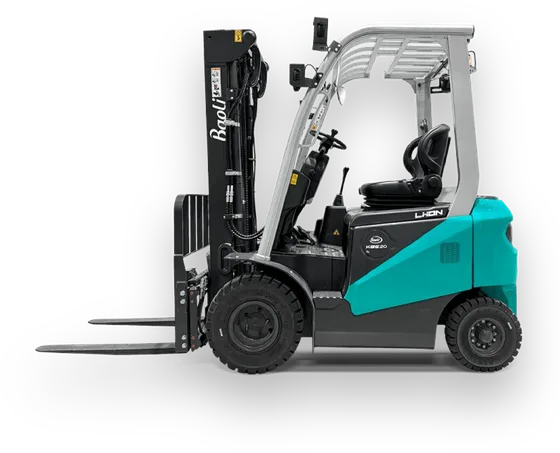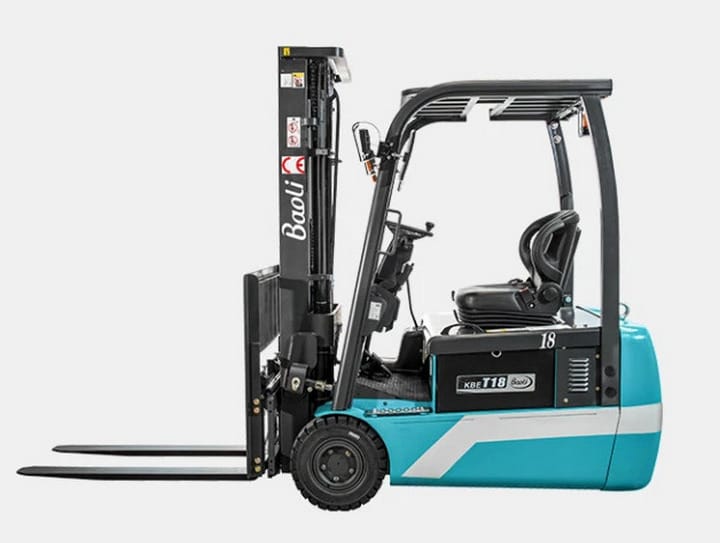
The car stands on four wheels and rolls over hard. A forklift looks the same, but it doesn’t sit the same — and that’s why an experienced car driver can make a mistake on their first day behind the wheel of a forklift.
This text explains why this is so, which six situations most often lead to tipping over, and what to do when it has already started.

Content
- Triangle of stability
- The combined center of gravity and why it keeps shifting
- Six situations that destroy stability
- What to do when the machine starts to tip over
- Why is the seat belt different here than in the car
- Prevention: machine, rules, man
Triangle of stability
A forklift has four wheels, but it relies on three points. The front wheels are two points. The rear axle is hinged so that the machine can follow an uneven floor — hence its third point the center of that joint, not the two rear wheels.
Those three points make stability triangle: wide base in front and top in back, in the middle.
There is one rule and everything else follows from it: while the common center of gravity of the machine and the load is inside that triangle, the machine stops. As soon as it comes out of it, it falls over.
What makes this dangerous is that it is a triangle narrow at the back. Laterally, there is considerably less room for error than it appears when looking at a four-wheeled machine.
The combined center of gravity and why it keeps shifting
An empty forklift has its center of gravity somewhere behind the front axle — the counterweight holds it at the back. When a burden is taken, it is gained common center of gravity of machine and load, and it moves forward and upward.
Three things move it:
- Mass of cargo — a heavier load pulls the center of gravity forward.
- Distance of cargo from villas — a load that is deeper or pushing the pallet forward moves the center of gravity forward, even when the mass is the same.
- Lifting height — the lifted load also raises the center of gravity, and a higher center of gravity means less resistance to lateral tilting.
That’s why the load diagram is not a number but a table — how to read it, we explained in the text about load diagram.
Six situations that destroy stability
1. Turning at too high a speed. In the curve, there is a force that pushes the center of gravity laterally, towards the edge of the triangle. The faster the speed and the narrower the circle, the stronger the force. This is the most common cause of a side roll, and it happens most often empty machines — because an empty machine drives faster and seems harmless.
2. Driving with a raised load. A lifted load means a high center of gravity. A machine that would go through the same curve with the load lowered without any problems, with the load raised, overturns. The rule is simple: the load is driven low, about 15–20 cm from the floor, with the mast slightly tilted back.
3. Slope. On a ramp or slope, the center of gravity moves downhill. That’s why it’s on a slope never turns i don’t drive across. You go uphill forward with the load, and downhill backwards — the load is always on the higher side.
4. Overloading or misplaced load. A load over the carrying capacity, a load hanging over the top of the forks, a load resting on only one fork or a pallet inserted only half way — all these move the center of gravity out of the calculation.
5. A hole, edge or obstacle. A wheel that falls into a channel, goes over a curb or hits an obstacle gives a sudden lateral impulse. On a machine with a raised load, that’s enough.
6. Sudden braking or sudden departure. Sudden braking with a raised load pushes the center of gravity forward and leads to tipping over the front axle. A sudden departure works the other way around, but with the same outcome for the load.
What to do when the machine starts to tip over
This is a part that every operator should know by heart, because the decision is made in seconds.
Do not jump out of the machine. It is an instinctive reaction and the most common cause of the most serious injuries. The operator who jumps out ends up in the zone where the protective frame of the machine falls — and the several-ton machine falls faster than the man can escape.
What is done:
- Stay in your seat. The protective frame and structure are there exactly for this case — they make up the space that remains free.
- Keep a firm grip on the steering wheel.
- Put your feet up in the cabin floor.
- Lean against the direction of the roll — the body goes to the rising side.
Those four steps are what separate a bruising accident from a serious accident.
Why is the seat belt different here than in the car
In a car, the seat belt protects against a forward impact. On a forklift the belt serves to keep you within the protective structure in the event of a rollover — so you don’t end up under the machine.
This is the reason why the saying “I drive slowly, I’m in the warehouse” doesn’t work. Overturning happens precisely at low speeds and in a familiar space, because that’s when you think the least.
It goes with the belt operator presence sensor on the seat — on most machines it prevents operation when the operator is not on the seat. It is not an obstacle to be overcome, but part of the same logic.
Prevention: machine, rules, man
The machine. Correct brakes, correct tires with equal axle wear, correct handlebars with no free play and chains that are not stretched. This is a daily check from the text of Fr maintenance plan and that’s why the list is organized the way it is. We have given signs that should not be ignored in the text five signs that the forklift needs service.
Space. Marked lanes for machines and separated for pedestrians, mirrors on corners, speed limit, clean and level floor without holes, enough room to turn at the end of the aisle. Most of these measures cost less than one accident.
Man. Training for safe work is a legal obligation of the employer and must have a practical part on the specific machine – we wrote about this in the text who is allowed to operate the forklift. An operator trained for one type of machine is not automatically trained for another, and the attachment changes both the load capacity and the center of gravity.
Choice of machine. Part of the problem is solved before it happens—with a machine that’s right for the job. A narrow aisle and high racks are demanding reach truck, and not frontal at the limit of the maneuver. An uneven lot requires a machine and tires for that terrain, not a machine for the hall.
If you’re not sure if the machine you have is right for the job you’re doing, tell us what your space looks like and what’s being transported — write to us or call 021/6040-505.