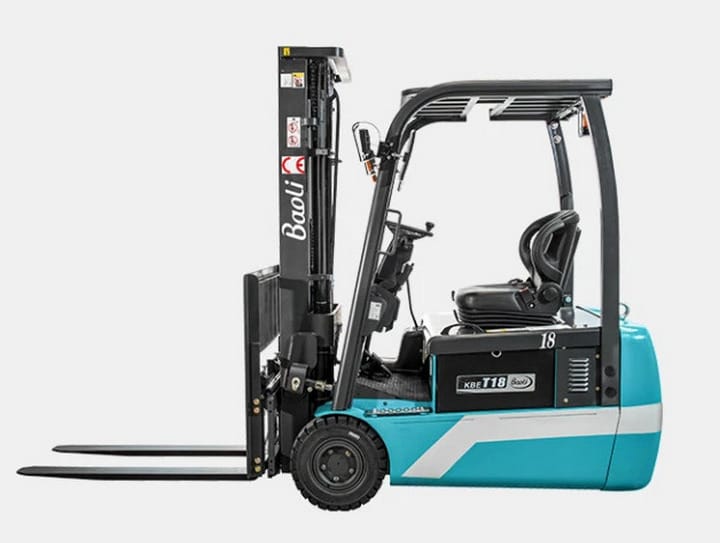
“He’s got a driver’s license, he’ll manage.” It’s probably the most expensive sentence uttered in a warehouse. A forklift does not drive like a car — it turns from the rear axle, its center of gravity changes with each lifted load, and the greatest number of accidents occur not while driving but during maneuvers with the load in the air.
That said, the legal side of the story is different than most expect. In Serbia, there is no state “forklift license” that would be issued as a driver’s license. There is something else, and that is the employer’s obligation.

Content
- Why is there no “forklift permit”
- What is training for safe work?
- When the training is done
- Increased risk and medical examination
- Records kept
- Training is for the machine, not for the person in general
- What if the forklift goes out on a public road
- Practical list for the employer
Why is there no “forklift permit”
A forklift in the company’s closed circle is not a vehicle in traffic, but work equipment. That is why it is not regulated by regulations on traffic safety, but by regulations on safety and health at work — and they do not know the state license, but the employer’s obligation to train the employee.
The practical consequence is important: there is no document that the operator “has” and carries with him from company to company. When he transfers to another employer, the new employer retrains him for his working conditions and his machines.
What is training for safe work?
Law on Safety and Health at Work (“Official Gazette of RS”, No. 35/2023) in Article 33 stipulates that the employer must train the employee for safe and healthy work. The law explicitly states that training is provided during working hours, and yes expenses are provided from the employer’s funds — so not in free time and not at the employee’s expense.
Training has two parts that go together. The theoretical part covers the dangers of the workplace, protective measures, rules of movement in the warehouse, the load diagram and handling in an emergency situation. The practical part is being done on the machine — pre-shift check, loading and unloading, reversing with raised load, parking, refueling or refueling.
Training ends with a check, and the result is recorded in the records. Paper without the practical part is not training but a formality that will not stand up to inspection or post-injury investigation.
When the training is done
According to Article 33 of the Law, training is carried out:
- when establishing an employment relationship — before the employee starts working
- when transferring to other jobs — the man who until yesterday worked in packaging, and from today drives a forklift, is a new operator
- when introducing new technology — a new machine of a different type or a new attachment falls here
For jobs with increased risk, a periodic qualification check is also provided. The deadline is determined in accordance with the employer’s regulation and act — check it with your occupational health and safety officer, as the entire training schedule in the company is derived from it.
Increased risk and medical examination
The handling of a forklift is defined in the act on risk assessment as a rule workplace with increased risk. This leads to two things that are often overlooked.
The first: the employee in such a position is referred to previous and periodic medical examination. Sight, hearing, balance and reaction are not a formality in a job where you maneuver a ton of cargo in the air.
Second: minors are not allowed to work with increased risk. A seventeen-year-old trainee is not allowed to sit on a forklift, no matter how dexterous he is.
Records kept
Records are prescribed Rulebook on the manner of keeping and the terms of keeping records in the field of safety and health at work (“Official Gazette of RS”, no. 5/2025, 38/2025, 118/2025 and 57/2026). For a warehouse with forklifts, the following are relevant above all:
| Form | Content |
|---|---|
| Form 1 | Workplaces with increased risk and medical examinations of their employees |
| Form 6 | Training for safe work and personal protective equipment |
| Form 8 | Inspections and checks of work equipment |
| Form 11 | Personal protective equipment issued |
Form 8 links this topic to the previous text in the series — Fr periodic inspection of work equipment. A correct machine and a trained operator are two halves of the same obligation; none alone is worth it.
Training is for the machine, not for the person in general
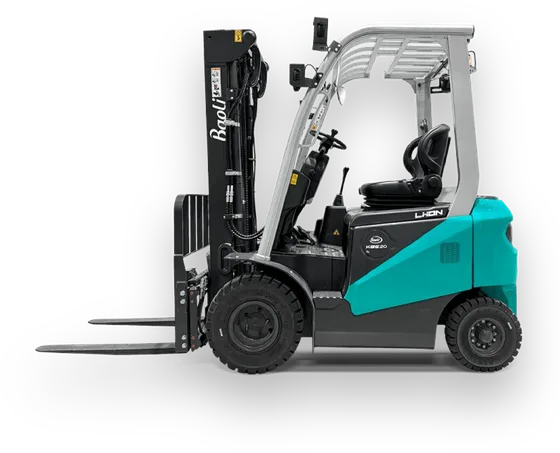
This is the most common mistake in practice. Operator qualified for a two-ton front-end forklift it is not automatically enabled for:
- a reach truck, which drives sideways and lifts more than ten meters — take a look KBR 14-20
- machine with attachment — rotator, bale catcher, extension forks; each connection changes the center of gravity and load capacity
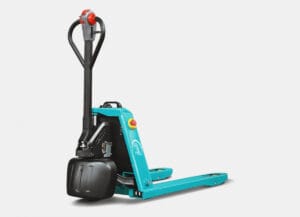
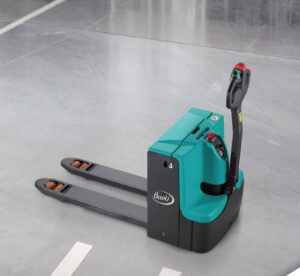
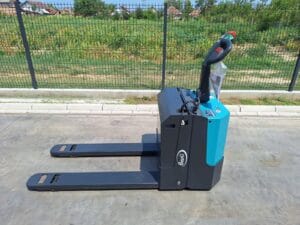
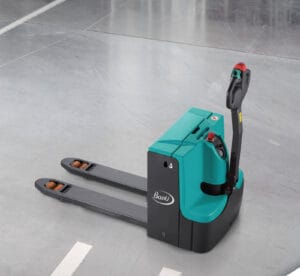
- electric pallet truck with a platform for the driver, which goes up to 12 km/h
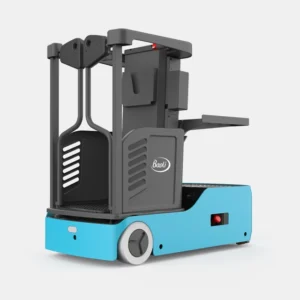
- platform for work at height, which is a special category of equipment
The rule is simple: a new type of machine or a new attachment means additional training and a new entry in the records.
What if the forklift goes out on a public road
Everything said above applies to work within the company. As soon as a machine crosses a public road — even if it is to cross from one yard to another across the street — the story changes and road safety regulations apply, with all that entails for the vehicle and the driver.
If this situation repeats itself, the solution is organizational, not improvisation: either the route is closed inside the circle, or the traffic section is regulated as required by the regulation.
Practical list for the employer
- a risk assessment act in which forklift operation is treated as a workplace with increased risk
- training for safe work, theoretical and practical part, with verification
- entry in Form 6, with date and signature
- medical examinations — previous and periodic, entry in Form 1
- supplementary training for each new type of machine or attachment
- issued personal protective equipment, entry in Form 11
- manufacturer’s manual available to the operator, not locked away in the office
- rules of movement in the warehouse — marked paths, speed limits, priority rules
We do not carry out the training – for that you contact the person or house for safety and health at work. What we do is to ensure that the machine is correct and that the operator knows how your model works: on delivery, we go through the machine with your people. For service and maintenance make an appointment here, for an offer use request for quotation or call 021/6040-505.
Note: this text is informative and does not constitute legal advice. Regulations change — before proceeding, check the current text of the regulations and consult an occupational health and safety officer.