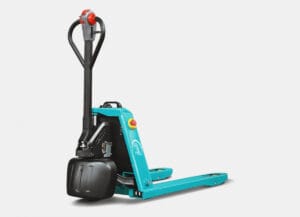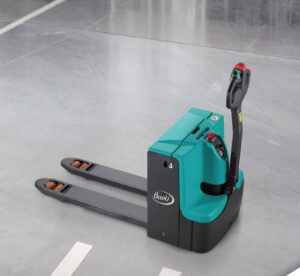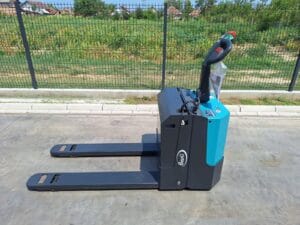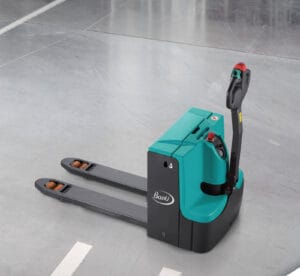
The pallet truck looks the same regardless of what’s on it. That’s why the carrying capacity of pallets is usually chosen by feeling — “carry a pallet, it’s enough” — and then it turns out that a pallet of tiles, cement, cans or bottled water is much heavier than anyone thought.
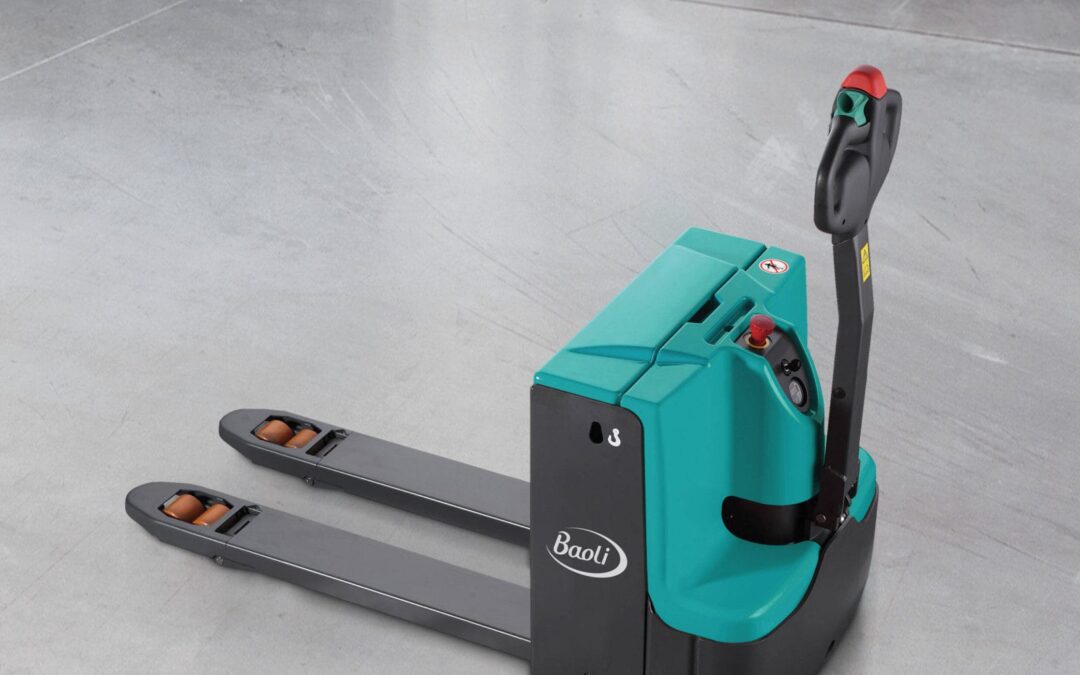
Baoli EP 25-N02 is the strongest model in the series, with a load capacity of 2,500 kilograms. This text explains when that reserve is really needed and when it is a waste of money.
Content
- When two tons are not enough
- Why load capacity is chosen with a margin
- AC motor and battery up to 350 Ah
- Power steering and 190° radius
- Slow motion option
- Who is it intended for?
- Where it stands in the series
- Table of specifications
- How to get an offer
When two tons are not enough
A few typical loads that regularly exceed two tons on a single pallet:
- ceramic tiles and stone slabs
- cement, mortar and glue in bags
- bottled water and drinks in glass
- canned goods and glass packaging
- metal profiles, sheets and reinforcement
- batteries, engines and machine parts
- books, paper and printed matter
If any of these are driven around your warehouse every day, the 2,500 kg class is not an exaggeration but a measure.
Conversely, if you’re handling packaging, textiles, convenience foods or ready-to-eat products in cartons, this machine is more than you need — cheaper models in the same series do the same job.
Why load capacity is chosen with a margin
The declared load capacity is a limit, not an operating point. A machine that works at its maximum every time wears out faster — the hydraulics, powertrain and battery are all working at their upper limit, and it shows over several years.
Rule of thumb: get a machine that has a load capacity of about one-fifth that of your heaviest regular load. If the heaviest pallet is about two tons, a 2,500 kg machine runs relaxed and lasts longer than a 2,000 kg machine that goes to the limit every time.
The measurement is not evaluated. If there is a scale in the warehouse, weigh a few of the heaviest pallets — it’s the cheapest way to make this decision accurately. If the goods are also weighed upon receipt, there is a machine that does this along the way: EPT20-15ET with built-in scale and printer.
AC motor and battery up to 350 Ah
It’s a drive AC motor. With AC motors, there are no carbon brushes to wear out, so there is one less maintenance job compared to older machines with DC motors. In addition, the AC motor holds the torque better when moving — which is exactly what is needed for heavy pallets.
It’s a battery 24 V, with capacities 160, 210 and 350 Ah depending on the performance. With the heaviest class in the series, a larger capacity makes sense: a heavier load consumes more per meter traveled, so the same battery lasts less than on a lighter machine.
The capacity is chosen according to how many hours a day the machine actually drives, not how long the shift lasts. We wrote about the choice and care of the battery in the texts lithium-ion or lead-acid battery i maintenance of the traction battery.
Power steering and 190° radius
The series has power steering i steering radius of 190°.
With a machine of this capacity, power steering is not an option but a requirement. Turning a two-and-a-half-ton pallet without servo assistance is a physical job that is repeated dozens of times an hour — and after a few hours, maneuver errors begin, not fatigue.
The 190° radius means that the ore turns over a full circle in both directions, so the machine can be turned virtually in place and driven sideways along the rack.
Slow motion option
The series offers slow motion option — maximum speed limit.
With the heaviest machine in the series, this is more valuable than with the others. Two and a half tons in motion has serious inertia: the stopping distance is longer, and hitting a rack or pallet is not damage but damage. In areas where there are pedestrians or where space is tight, a limited speed is cheaper than a rack repair.
Who is it intended for?
EP 25-N02 makes sense when:
- pallets weighing more than two tons are regularly driven
- goods are dense — building materials, glass, metal, drinks
- the routes are medium to longer, indoors with a flat and hard floor
- it is done daily, in one or two shifts
- security requires a speed limit in the warehouse area
If they light up and go up in the rack, you need one stacker or forklift, not a pallet truck — we explained the difference in the guide pallet truck, stacker or forklift.
Where it stands in the series
| Model | Carrying capacity | For what |
|---|---|---|
| EP 16-N01 | 1,600 kg | forks 540 or 685 mm, pallets and across |
| EP 20-N04 | 2,000 kg | work in the truck and on the ramp |
| EP 25-N02 | 2,500 kg | the heaviest loads in the series |
All three share the same base — AC motor, power steering, 190° radius, slow motion option and up to 25cm lift. We wrote about the compact model in the text Baoli EP 16-N01, and about the two-ton model in the text Baoli EP 20-N04.
Table of specifications
| Item | Value |
|---|---|
| Carrying capacity | 2,500 kg |
| Engine | alternating current (AC) |
| Battery | 24 V; 160 / 210 / 350 Ah |
| Management | power steering, radius 190° |
| Lifting height | up to 25 cm |
| Option | slow motion |
| Guarantee for legal entities | 12 months* |
How to get an offer
Send us four pieces of information:
- the weight of the heaviest pallet you drive regularly — measured, not estimated
- the type of pallet you are using
- narrowest aisle width and turning space
- how many hours a day the machine is actually in motion — the battery capacity depends on it
With that data we select the battery performance and check that the machine fits in your space before anything is ordered. Write through request for quotation or call 021/6040-505.
Baoli electric pallet trucks on offer
Look at the models we offer and choose the performance for your business.
Payment for registered business entities in the Republic of Serbia is made in dinar equivalent at the middle exchange rate of the NBS on the day of payment. The guarantee for legal entities is 12 months*.
You have the whole category on the page pallets, and you can service schedule here.
* The guarantee is contracted in accordance with the valid laws of the Republic of Serbia.