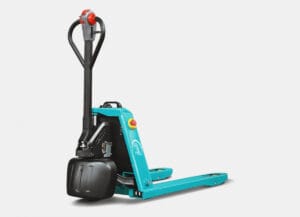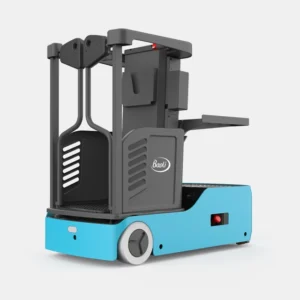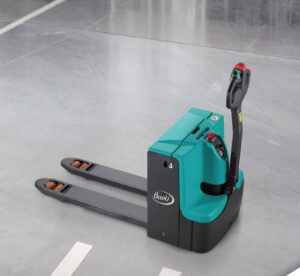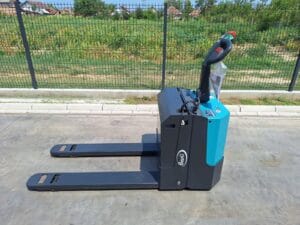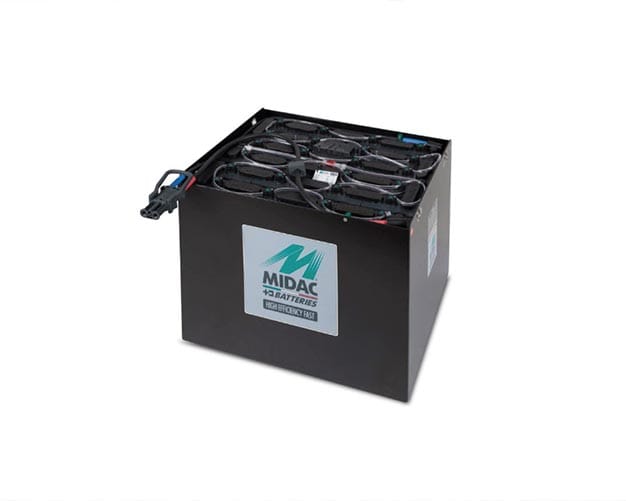
The traction battery is the single most expensive part of an electric forklift. He knows that it costs as much as a used machine. Despite this, in most plants it is treated like a tank: it is filled when it is empty, water is added when someone notices, and that is it.
The result is a battery that lasts two and a half years instead of five years. This text is a list of habits that determine that difference.

Content
- How the battery really dies
- Rules for charging a lead-acid battery
- Topping up water: only distilled and only after filling
- How much can be emptied
- Purity, poles and temperature
- How to measure battery health
- What about the battery when the machine is standing for a long time
- What is different about lithium
- When the battery is really dead
How the battery really dies
A lead-acid traction battery does not fail suddenly. It slowly loses its capacity, for three reasons that almost always occur together.
Sulfation. When the battery is discharged, lead sulfate crystals form on the plates. The longer it sits empty, the bigger and harder the crystals are. In the early stage, they are partially decomposed by filling; not later. Sulfation is an irreversible process and is the most common cause of premature battery death.
Deep discharge. Each discharge below the recommended limit consumes more than one cycle from the battery life. A few months like that and a battery that was supposed to last 1,500 cycles gives them 800.
Overheating and lack of electrolytes. Charging heats the battery and consumes water. If the electrolyte level drops below the top of the plates, the plates are permanently damaged — and that part of the capacity is not restored by adding water.
Rules for charging a lead-acid battery
- Fill it all the way, every time. Interrupted loading is the worst habit in the warehouse. A battery that is constantly charged “to half” loses capacity quickly and permanently.
- Do not break the cycle. If charging has started, let it finish. “Just to drive one pallet” costs more than it seems.
- Do not refill randomly. Short top-ups during a shift, without a full cycle, work against you with a lead-acid battery — unlike a lithium, where they’re perfectly fine.
- Allow the battery to cool before the machine starts again. A warm battery wears out faster.
- Do an equalizing charge according to the manufacturer’s instructions. It equalizes the charging of the cells, which otherwise go in different directions over time.
- Use the correct charger. The charger must match the voltage and capacity of the battery. Improvisation here shortens the century the fastest of all.
- Charge in a ventilated area. Hydrogen is released during filling — open flames, sparks and smoking are out of the question in that area.
Topping up water: only distilled and only after filling
Two mistakes are made all the time, and both are costly.
First: topping up plain water. Tap water contains minerals that settle on the plates and permanently reduce capacity. Only distilled or demineralized water is used.
Second: topping up before filling. The electrolyte level rises during charging. If it is topped up too soon, the electrolyte spills over the top of the cells — acid is lost, the case is corroded and the concentration changes. Water is added after charging is complete, to the level marked on the cell.
The level is checked once a week for machines that run daily. If a cell is constantly asking for more water than the others, it is a sign that that cell is weakening and worth measuring.
How much can be emptied
Rule of thumb for a lead-acid traction battery: not below about a fifth of the remaining capacity. The pointer on the machine usually has a red zone precisely because of this – when it enters it, the machine goes to the charger, not “one more round”.
Many machines have protection that turns off the lift when the charge is low, and leaves the drive. It’s not a bug, it’s a deliberate solution: the machine can be brought to the charger, but it can’t continue to run and drain the battery.
If the red zone is reached every day before the end of the shift, the problem is not in habits but in capacity — the battery is too small for the operating mode, or has already lost capacity.
Purity, poles and temperature
Dust and moisture on the top of the battery create a conductive layer that slowly drains the battery even when the machine is standing still. The upper side is wiped with a dry cloth; never wash with water under pressure.
Poles and connections are checked for oxidation and tightness. A loose connection heats up, and a heated connection damages both the cable and the pole connection.
Temperature: the battery works best at room temperature. In the cold, the capacity drops temporarily — in a cold store or non-insulated warehouse in winter, the machine works for less time, and this is not a malfunction. In the heat, the battery wears out faster and loses more water, so the electrolyte level is checked more often in the summer.
How to measure battery health
With a lead-acid battery with a liquid electrolyte, the density of the electrolyte is the best indicator of condition. It is measured with a hydrometer, by cells, and that after full charging.
A charged cell is approximately at 1.28 g/cm³, discharged at about 1.16. Specific values are provided by the battery manufacturer and should be followed.
The most useful finding is not the average but the difference between cells. If one cell deviates from the rest, it drags the whole battery down and is worth measuring before deciding the fate of the kit.
What about the battery when the machine is standing for a long time
A collective vacation, a winter break, a machine waiting for work — these are all situations in which batteries are most destroyed, and no one uses them.
- Leave the battery fully charged, never empty.
- Separate it from the consumer if possible.
- Leave it in a cooler place, but not at minus.
- Refill it about once a month, because it empties itself when standing.
A battery left empty over the summer often does not recover. It is a malfunction that is not seen in August, but in October when the machine works for two hours instead of eight.
What is different about lithium
With a lithium-ion battery, almost the entire list above falls away: no water topping up, no equalizing charge, no density measurement, no hydrogen release, and no full charge rule — partial charge is just fine.
Three remain: use a working charger, avoid working and charging on extreme temperatures, and do not leave the battery completely empty for a long period. Partial filling is recommended for storage, according to the manufacturer’s instructions.
We have provided a detailed comparison of the two technologies in the text lithium-ion or lead-acid forklift battery.
When the battery is really dead
Signs that together say it’s time for a replacement:
- the machine runs much shorter than before, with the same job
- the battery charges quickly and discharges quickly — the capacity is gone
- one or more cells constantly deviate in density
- the battery heats up significantly when charging
- consumes an unusually large amount of water
- crate damage, leakage or deformation is visible
A new battery in a working machine is significantly cheaper than a new machine, and is often the fastest way to get an old machine back to full working order. You have an offer on the page batteries for forklifts.
If you are not sure whether the problem is with the battery or the charger, we will measure it. Schedule a service or call 021/6040-505. Regular battery checks are part of it maintenance plan — we gave the whole interval routine there.
Batteries for forklifts on offer
Look at the models we offer and choose the performance for your business.