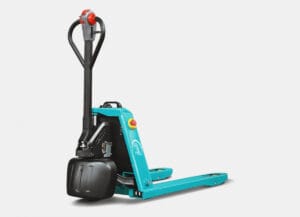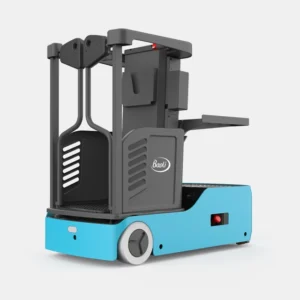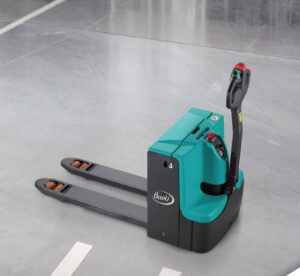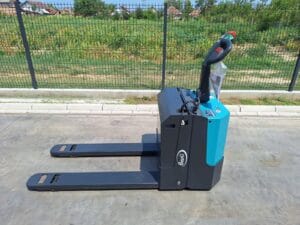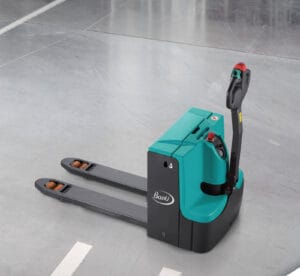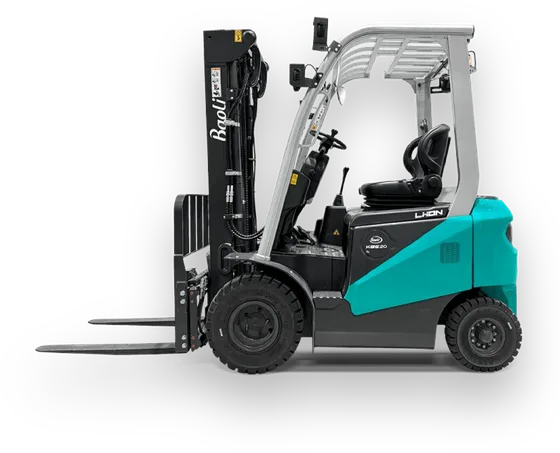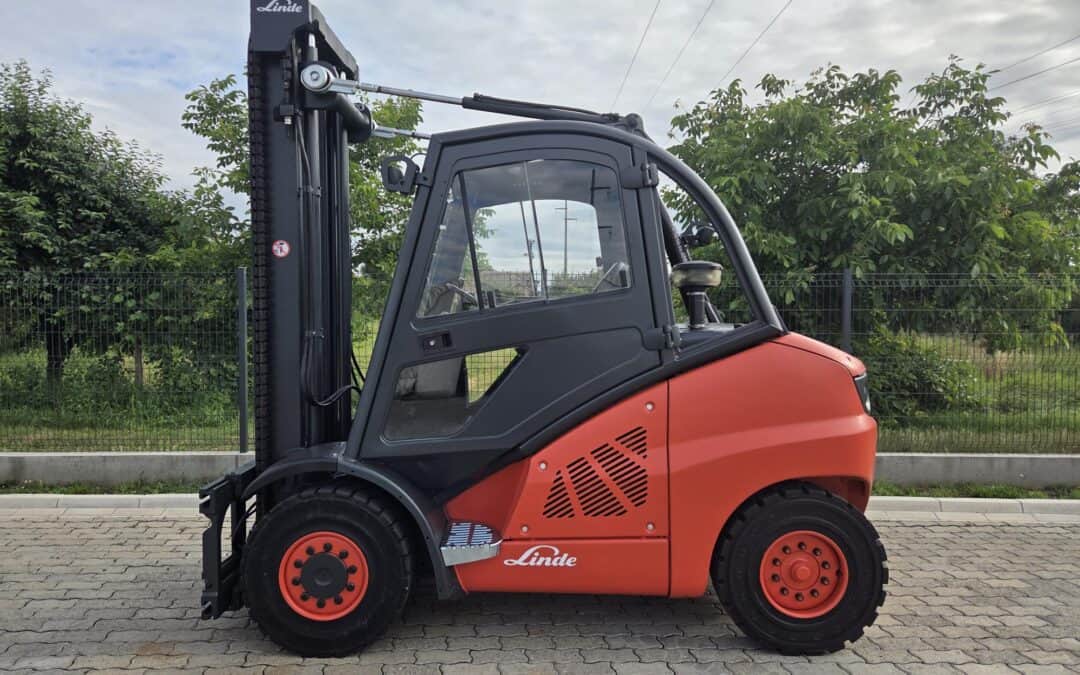
“We took a two-and-a-half-ton machine, and it can’t lift a two-ton pallet.” We hear this phrase several times a year, and almost always it’s not a malfunction. The point is that the number in the model name is not a promise — but a value valid under certain conditions.
The load capacity of the forklift is a set of values, not a single number. It changes with the shape of the load, with the height of the lift and with each attachment that is hung on the mast. All this is written in two places: on the nameplate of the machine and in the load diagram.
This text explains how to read those two documents — and how to make sure the machine really does the job for you before you buy.
Content:
- Load center of gravity: what does “at 500 mm” mean?
- Triangle of stability
- Example: how much the load capacity drops when the load is lengthened
- Lifting height and residual load capacity
- Connections take two times
- Name plate and diagram
- Four common mistakes
- How to check before you buy
Load center of gravity: what does “at 500 mm” mean?

Each declared load capacity is accompanied by a condition: at a load center of 500 mm. For heavier machines, over five tons, the standard is often 600 mm.
The center of gravity of the load is the horizontal distance from the vertical part of the forks to the point where the load is “balanced”. For an evenly loaded pallet, this is approximately half its depth.
There is a misunderstanding that costs money. Euro pallet is 1,200 × 800 mm — so the same palette has a different center of gravity depending on which side it is taken from:
- taken from the side of 1,200 mm, load depth is 800 mm → center of gravity approx 400 mm;
- taken from the side of 800 mm, load depth is 1,200 mm → center of gravity approx 600 mm.
In other words, turning the pallet ninety degrees changes the load on the machine—without adding or subtracting anything.
Triangle of stability
Why does it even matter how far the load is? Because the forklift does not “hold” the load by force, but by force counterweight and geometry.
The front loader rests on three points: the two front wheels and the center point of the rear axle, which rotates. Those three points make stability triangle. As long as the common center of gravity of the machine and the load is inside that triangle, the machine stops. Once out of it, the machine tilts — forward or sideways.
The load on the forks acts as a lever: the further it is from the front axle, the greater the torque that tries to tip the machine forward. The counterweight at the rear does the opposite. The declared load capacity is the point where the two moments are kept in a safe relationship.
The same rule explains why rollovers most often occur in a corner with a raised load: the lift moves the common center of gravity up, and the turn throws it sideways out of the triangle. We will write about this in a separate text.
Example: how much the load capacity drops when the load is lengthened
There is an approximate calculation which, before looking at the diagram, gives an order of magnitude. It compares the lever arms — the distance from the front axle to the center of gravity of the load.
Let’s take a machine declared at 2,500 kg at 500 mm, where the distance from the front axle to the front of the forks is about 450 mm. The lever arm is then 450 + 500 = 950 mm.
| Center of gravity of the load | Lever arm | Approximate load capacity |
| 500 mm (declared) | 950 mm | 2,500 kg |
| 600 mm (pallet lengthwise) | 1,050 mm | about 2,260 kg |
| 700 mm (long case) | 1,150 mm | about 2,065 kg |
So: the load moved by only twenty centimeters took away about 435 kg load capacity — seventeen percent. A “two and a half ton” machine is no longer a two and a half ton machine at that point.
We emphasize: this is approximate estimate by an order of magnitude, useful while discussing the offer. Only the manufacturer’s load diagram for the specific configuration is applicable.
Lifting height and residual load capacity

Another variable is height. What the machine carries on the highest shelf is called residual (remaining) load capacity and as a rule it is smaller than declared.
The reason is twofold. Lifting the load moves the common center of gravity up and reduces lateral stability, and a taller mast is itself heavier and moves the mass forward. That is why the same machine with a 6,500 mm mast has a lower residual load capacity than the same machine with a 3,300 mm mast — and the difference can be significant in the upper third of the stroke.
This is also the reason why the “biggest mast just in case” is not chosen when configuring the machine. The height you don’t need is paid for twice: at the time of purchase and in the capacity you lost.
With each model we presented — from KBET 15-18-20 to KBD/G 25-35 — that’s why we repeat the same question: how heavy a pallet goes to what height.
Connections take two times
Each one connection — side shifter, fork extensions, bale tongs, rotator, extended roll fork — reduces payload in two ways at the same time:
- By its own weight. Attachment is the load the machine carries before it picks up your pallet.
- By moving the center of gravity forward. The attachment pushes the load away from the mast and extends the boom arm — same as in the calculation above.
Fairy extensions are the most insidious here, as they look innocuous. A fork extended by half a meter does not mean that the machine can carry a longer load of the same weight — it means that the center of gravity of that load has been moved forward, often by twenty centimeters.
The rule is simple: when a connection is added, the new load capacity and new nameplate apply, not the factory one.
Name plate and diagram
The name plate is a document of the machine. It has the serial number, model, curb weight, battery or motor type, and — most importantly — carrying capacity with the conditions under which it is valid: center of gravity of load and maximum lifting height.
The load diagram is a graphical representation of the same: on one axis is the lifting height, on the other is the center of gravity of the load, and the curves show how much the machine can carry in each combination. It reads from the bottom up — you find your height, track to your center of gravity, and read the kilograms.
Three rules that go along with it:
- The tile must be readable. A faded or repainted plate is reason not to operate the machine until it is renewed.
- The tile must match actual configuration — the mast, tires and attachments on the machine.
- The plate and diagram are part of the required documentation periodic review. That’s why we look for them in every used machine – we wrote about that in checklist for buying a used forklift.
Four common mistakes
1. Choosing a machine by average pallet. The machine is selected by the heaviest pallet that appears, and by the least favorable shape of the load — not by what is most common.
2. Ignoring the shape of the load. Two loads of the same mass, one compact and one long, are not the same load. Pipes, profiles, crates and rolls require checking the center of gravity.
3. Assessment “by eye”. If you don’t know how much the pallet weighs, measure it. A pallet truck with a built-in scale does this by the way — we’ve already written about that possibility.
4. Adding a connection without a new check. A connection mounted subsequently changes the load capacity, and this must be documented.
How to check before you buy
Before you sign anything, gather four numbers about your business:
- The weight of the heaviest pallet — measured, not estimated.
- Load depth and from which side the pallet is taken.
- The highest shelf where the load goes.
- Connections which will be on the machine.
With those four pieces of information, you’re looking for a load chart for exactly that configuration — not for the series, but for the machine you’re being offered. If the seller doesn’t have it, that’s information for itself.
With us, those four questions are a standard part of the pre-offer conversation, precisely because this is where most mistakes are made. If you want us to check your case, please send request for quotation, fill in forklift truck selection questionnaire, call 021/6040-505 (Monday–Saturday, 7:00–15:00) or write to info@viljuskari-jovic.rs.
And if you’re still not sure what class of machine you even need, start with the guide Pallet truck, stacker or forklift?