In most companies, work at heights is solved by improvisation. The ladder is there, the scaffolding can be borrowed, and the forklift with a pallet instead of a basket is a classic that everyone knows and that is not talked about out loud. All three options have the same flaw: none are built for the job at hand.
The scissor lift is the machine that it is. In this text, we explain how to choose — according to height, carrying capacity and width of passage — and where is the limit after which it is paid off.

Content
- When ladders and scaffolding stop being cheap
- The working height is not the height of the platform
- Carrying capacity: people plus tools plus material
- Width and dimensions — the most common mistake when choosing
- Scissors, articulated and telescopic
- Three models from our offer
- The platform is the equipment for work
- How to choose in five minutes
When ladders and scaffolding stop being cheap
The ladder is unbeatable for a single screw. The problem starts when the work is ongoing. You work on the ladder with one hand, because you hold on with the other; tools and materials stay down; and every movement to the side means a descent, a shift and a re-ascent. In a job that lasts two hours, that’s a few dozen descents.
The scaffolding is stable and good when working in one place for a long time. But assembly and disassembly take time, require people and space, and if the work is moved along the hall, the scaffolding is disassembled and assembled again.
The platform solves exactly that part: both hands are free, tools and materials are up there with you, the fence is serial, and moving takes as long as driving a few meters. When time is added up, the platform in a facility that regularly operates at height returns faster than it looks.
The working height is not the height of the platform
This is the only figure worth understanding before comparing anything.
- Platform height — until the floor you stand on rises.
- Working height — the height of the platform increased by about two meters, which is calculated to be a man’s reach with his hands above him.
That’s why the platform with working height of 7.8 meters has platform height of 5.8 meters. If you need to reach an eight-meter lamp, you’re looking for a platform with a working height of about eight meters — not an eight-meter platform height, because that’s a much larger and more expensive machine.
Measure from the floor to the point where you are working, and ask for a working height that is half a meter higher. The reserve exists because the floor in the hall never coincides with the ideal one, and also because it is not worked for maximum extraction.
Carrying capacity: people plus tools plus material
Another figure that is miscalculated. The carrying capacity of the platform is not “how many people fit” but the total mass of everything on the platform.
One man with a tool is realistically 100 to 120 kilograms. Two people with tools and a box of materials easily exceed 250. The 230 kg platform is therefore a machine for one man; if working in pairs or bringing material up, you need 400 kg and more.
This is not an item to skimp on: exceeding the load capacity at a height of six meters is not a malfunction, but a tipping over.
Width and dimensions — the most common mistake when choosing
The platform is chosen for its height, bought for its load capacity, and returned for its width. The machine must pass through doors, between racks and, if used on multiple floors, into an elevator.
Before choosing, measure three things: the narrowest opening the machine must pass through, the lowest lintel, and the load-bearing capacity of the floor if working upstairs. A narrow platform of about 76 centimeters passes through a standard door; a meter and a half wide platform does not pass, no matter how good it is.
Scissors, articulated and telescopic
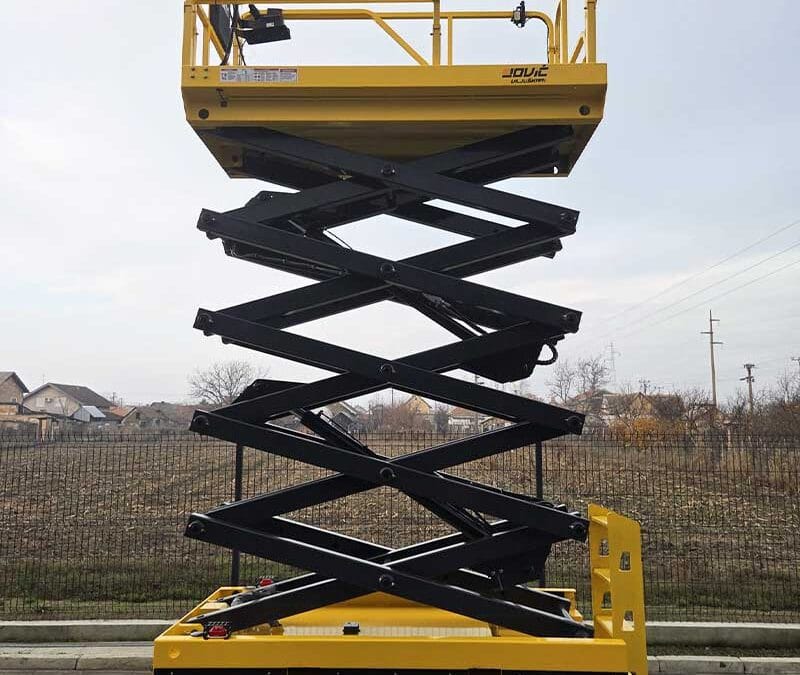
Scissors the platforms rise straight up. They have the largest platform and the largest payload for their class, are stable and easy to manage. They cannot bypass the obstacle — what is above them, they reach; what’s behind the machine, no.
Jointed they have an arm with a joint, so they can “sneak” over the obstacle and approach the point from the side. They are more expensive and have a lower load capacity.
Telescopic they give the greatest lateral reach and the greatest heights, and are mainly machines for construction sites and outdoor work.
For work in halls, warehouses, shopping centers and production — maintenance of installations, lighting, ventilation, cleaning, assembly — the scissor lift covers the vast majority of the work.
Three models from our offer
| MX580S | MX600SN | MX1000S | |
|---|---|---|---|
| Working height | 7,8 m | 7,8 m | 12 m |
| Platform height | 5,8 m | 5,8 m | 10 m |
| Carrying capacity | 230 kg | 500 kg | 320 kg |
| Platform | 1,67 × 0,74 m | 2,3 × 1,15 m | 2,3 × 1,15 m |
| Gauge | 1,68 × 0,76 × 1,84 m | 2,475 × 1,18 × 1,73 m | 2,45 × 1,18 × 2,48 m |
| Mass | 1,500 kg | 2,300 kg | 2,750 kg |
A quick read: MX580S is a narrow machine that passes through a standard door and is intended for one person — lighting service, installation, maintenance in a store or small hall. MX600SN it has the same height but twice the platform and a load capacity of 500 kg — two with material. MX1000S is the choice when working at ten meters and more.
All three are self-propelled and battery operated — they do not need an external power source or generator, which is a requirement for indoor operation.
The platform is the equipment for work
This is often overlooked: an aerial work platform is work equipment, just like a forklift. The same obligations follow from this — periodic inspection and verification by a licensed legal entity, training of the employee for safe work and record keeping.
We wrote about the review in the text periodic inspection of work equipment, and about training in the text who is allowed to operate the forklift. An operator qualified for a forklift is not automatically qualified for a platform — that’s a different type of equipment.
How to choose in five minutes
- Measure the height to the working point and add half a meter of allowance. It’s yours working height.
- Get the mass of people, tools and materials going up. It’s yours carrying capacity.
- Measure the narrowest opening the machine must fit through and the lowest lintel. It’s yours gauge.
- If you need to reach a point behind an obstacle — scissors do not solve the problem, look for an articulated one.
Send us those three numbers and tell us where they work, so you get a model, not a catalog. Use it request for quotation or call 021/6040-505. You have the whole category on the page platforms for working at height.
In subsequent articles in this series, we go through all three models individually — starting with the MX580S.
Platforms for work at height on offer
Look at the models we offer and choose the performance for your business.