When choosing a forklift, the first question is almost always the same: how much does it cost. The answer to that question is the bid number — and that number, viewed over the life of the machine, is a smaller part of the story.
Manufacturer Crown Equipment states in its total cost of ownership analysis that the operator’s work accounts for up to 77 percent of the total cost of one machine throughout its life. That percentage applies to markets with significantly higher labor costs than ours, so it’s not that big here. But the direction is the same and worth remembering: the machine is paid for once and works for thousands of hours.
That is why offers should not be compared by price, but by cost per working hour. In this text, we show how that number is calculated, with a concrete example in which a more expensive machine turns out to be cheaper — and with instructions to do the same calculation for your case.
Content:
- The purchase price is the ticket, not the price
- Six items that make up the hourly cost
- Example: diesel vs electric engine
- The item that everyone forgets: the cost of standing
- How to calculate your number
- What does this mean when shopping?
The purchase price is the ticket, not the price

A 10,000-hour forklift isn’t a product you buy — it’s a service you buy in advance. Those 10,000 hours are what you’re really paying for, and the quote price is just the first installment.
If a 25,000-euro machine works 10,000 hours, its procurement participates with 2.50 euros per hour. Fuel, service and operator in the same hour often cost many times more. And yet, a discount of one thousand euros on the purchase is being negotiated, while the items that will make a tenfold difference in ten years are not opened at all.
Cost per labor hour corrects that perspective. It is also the only way to fairly compare machines of different drives, different ages and different classes.
Six items that make up the hourly cost
1. Depreciation of the machine. The purchase price minus the estimated resale value, divided by the number of working hours you expect. Here you can see why it is important to ask how many hours the machine has, not how old it is.
2. Energy. Diesel, LPG or electricity. This is the item with the biggest difference between plants and the easiest to measure — hourly consumption times energy cost.
3. Regular service. Oils, filters, lubrication, periodic inspections. A predictable cost that is planned by the hours of work, as with the vehicle.
4. Consumable and wearing parts. Tires, brakes, chains, hoses, forks. With used machines, this item comes earlier and is larger.
5. Battery, for electric machines. The traction battery is a separate expense with a lifetime of approximately 1,500 cycles. Her replacement is planned, not anticipated. You can find more details about it on the page batteries for forklifts.
6. Work of the operator. The largest single item in most accounts. The total cost of the employee divided by the number of hours spent on the machine.
The seventh item exists, but it is not planned, but happens — more about it below.
Example: diesel vs electric engine
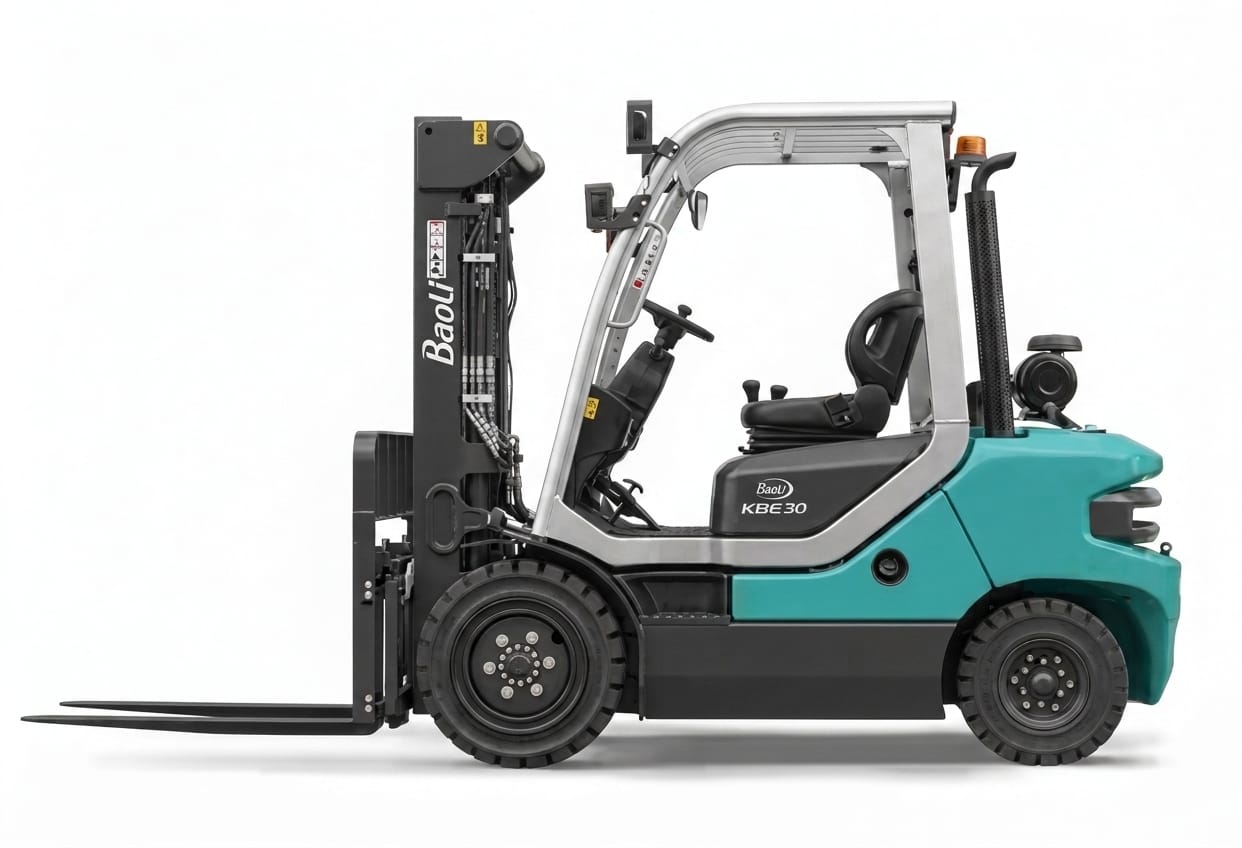
Let’s take two machines of the same class — carrying capacity of about 2.5 tons, work in the hall, 1,500 working hours per year, expected life 10,000 hours. The numbers below are illustrative assumptions, not the price list: replace them with your actual values, because the fuel price, electricity tariff and labor cost differ from company to company.
| Item (per working hour) | Diesel | Electric |
| Depreciation of the machine | 2,00 € | 2,40 € |
| Energy | 5,10 € | 0,80 € |
| Service and parts | 2,00 € | 1,20 € |
| Battery depreciation | — | 0,55 € |
| Machine cost | 9,10 € | 4,95 € |
| Work of the operator | 6,00 € | 6,00 € |
| Total per hour | 15,10 € | 10,95 € |
In the example, the diesel machine cost €25,000, and the electric one €30,000 — so €5,000 more expensive when purchased. The difference in cost per hour is 4,15 € in favor of electricity.
Share with each other: 5,000 ÷ 4.15 ≈ 1,205 working hours. At 1,500 hours a year, that is less than ten months of work. After that, the more expensive machine is cheaper every hour, and over a lifetime of 10,000 hours, the difference in favor of the electric passes 36,000 euros.
Make no mistake: this does not mean that an electric machine is always a better choice. It means that the purchase price comparison misses the point. For work in the open, on rough terrain, with heavy loads or in two shifts without space for charging, the bill looks different — and then diesel or LPG engine gets The point is to make a decision based on the bill, not the first number.
The item that everyone forgets: the cost of standing
The seventh item does not appear in any offer, and it can be the largest: what is the cost of an hour in which the machine is not working.
When a forklift stops, it’s not just the forklift that stops. Unloading stops, the truck is waiting on the ramp, three men are waiting for the pallet, and the ordered goods are late. The cost of that hour isn’t the cost of the spare part — it’s the people and processes that stand still. In a warehouse where three people work on unloading, one hour of downtime costs more than the entire day’s fuel consumption.
That’s why questions that at first glance have nothing to do with the price are included in the calculation: who services that brand in Serbia, how long to wait for the standard part, i is there a replacement machine while yours is being repaired. A machine that is cheaper by 2,000 euros, and waits for a part for two weeks, is not a cheap machine.
It’s worth it for the same reason regular service according to plan: the planned downtime is contracted for Saturday, and the unplanned one comes on the day when the largest delivery arrives.
How to calculate your number
The calculation takes fifteen minutes and is done once. You need four pieces of information:
- How many hours does the machine work per year? If you have a counter, take the actual difference between the two years — not the estimate.
- Expected life in hours. For a quality machine, expect 10,000 to 20,000 hours, with an earlier limit for more difficult conditions.
- Energy price per hour. Measure your consumption in a normal week and multiply by your fuel price or electricity tariff.
- Total operator cost per hour. The gross cost of an employee divided by the number of working hours.
Then add up: depreciation + energy + service + parts + battery + labor. The resulting number is what one hour of work really costs you — and you can use it to compare each subsequent offer.
If your annual number of hours is small, the bill often shows a third possibility: that you don’t buy the machine at all. We wrote about it in the text Forklift rental: how to save money and time.
What does this mean when shopping?
Three things worth taking away from this account:
- The purchase discount is the smallest leverage. A thousand euro discount on a machine that works for 10,000 hours is worth €0.10 per hour. Half a liter of fuel less per hour is worth more.
- A machine adapted to the job is cheaper than a machine “with a reserve”. Carrying more than you need is paid for in procurement, consumption and maneuvering — every hour.
- Comparing a used and a new machine only makes sense per hour. How it looks in practice, we wrote in the text Used or new forklift: how to decide, and what class of machine do you even need — in the guide Pallet truck, stacker or forklift?
If you want us to do that calculation together for your specific case, we need three pieces of information: how many hours a day the machine works, what is the heaviest pallet i to what height it rises. Based on that, we give you a proposal and hourly cost, so compare with what you have now.
Send it request for quotation, call 021/6040-505 (Monday–Saturday, 7:00–15:00) or write to info@viljuskari-jovic.rs.
Prices are published in euros without VAT and refer to registered economic entities; payment is made in dinar equivalent at the middle exchange rate of the NBS on the day of payment. It goes with new machines guarantee for legal entities lasting 12 months*.
* The guarantee is contracted in accordance with the valid laws of the Republic of Serbia.