The magazine rarely expands to the side. When space runs out, goods go up — and that’s where most drives run into the same wall. The forklift must stop in front of the rack, turn towards it and have enough space behind it to maneuver. That space is a passage of three, often three and a half meters, and these are squares that carry nothing.
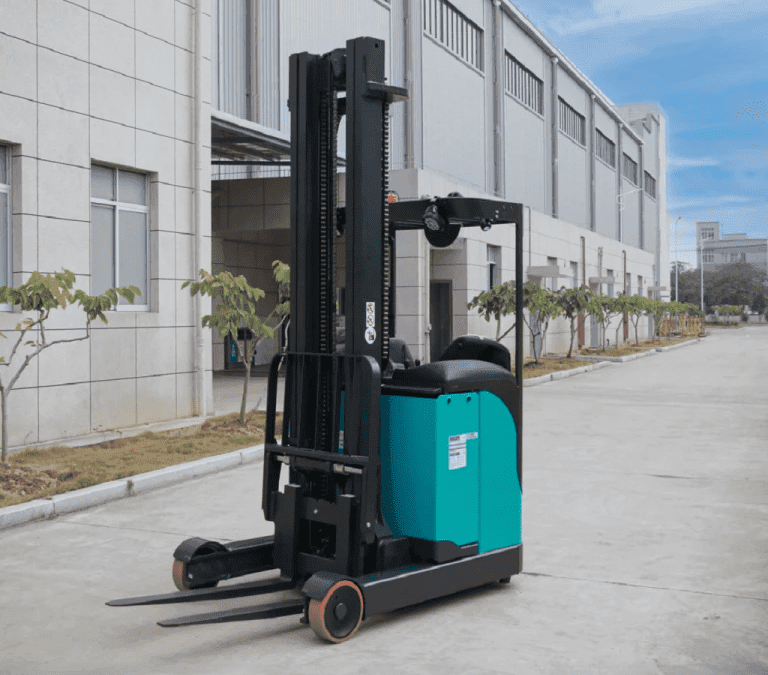
The Baoli KBR 14-20 is the answer to that calculation: a reach truck that works in a much narrower aisle and lifts up to 10,655 mm, in capacities of 1,400, 1,600 and 2,000 kilograms.

Content
- A calculation that is not visible on the invoice
- How a pallet truck works
- Height of 10.6 meters
- Four control modes
- Battery and motors
- Operator’s workplace
- Who is it intended for?
- Table of specifications
- How to get an offer
A calculation that is not visible on the invoice
Take a hall with ten rows of racks. If the aisle between them is reduced by one meter, you get ten meters of width for ten aisles — enough for another whole row of racks, sometimes two. These are new pallet positions without a single square of added hall and without a single day of downtime.
The other half of the calculation is height. A six-meter rack and a ten-meter rack occupy the same floor. The difference is that the second one holds almost twice as much merchandise — but only if you have a machine that gets there.
When these two things are added, the reach truck ceases to be an expensive machine and becomes the cheapest way to increase the warehouse.
How a pallet truck works
With a front-end forklift, the load is always in front of the front wheels, so the machine needs a counterweight and space to turn towards the rack. A pallet truck works differently: the mast is extended forward towards the rack and the machine remains in place. When the load is lifted, it returns between the supporting legs, within the dimensions of the machine.
Two things emerge from this. The first — there is no need for a large counterweight, so the machine is lighter and more compact. The second — it does not turn towards the rack, but drives along the aisle and pulls out the mast, so the aisle is much narrower.
The price of that advantage is the terrain: a reach truck requires a flat, hard and clean floor. Not a machine for a lot, a ramp in the rain or a messy yard. That’s what it’s for another category of machines.
Height of 10.6 meters
The series goes up to 10,655 mm. At that height, the pitches are no longer visible from the cabin the way they are at two meters, and that’s where the decision is made whether the machine is running fast or being felt.
That’s why auxiliary systems go with the height — a camera and screen for working at height, a height indicator, a laser pointer and systems that limit the speed of lifting and driving when the load is lifted. Which of these goes to your machine is chosen during configuration based on how high it actually runs.
An important note that is often overlooked: load capacity decreases with height. A 2,000 kg machine does not lift two tons for 10 meters. Before ordering, always look at the load diagram for a specific configuration — how to read it, we explained in the text about load diagram.
Four control modes
KBR has four control modes — 180° and 360°, each in standard and inverse motion. That sounds like a technical detail, but in practice it’s the difference between an operator who works at his own pace and an operator who fights the machine.
The 360° mode allows the machine to be turned virtually in place, which is valuable at the end of the aisle. Inverse motion allows the operator to maintain the same control logic when driving in the opposite direction, rather than mirroring the movements in the head.
It goes serially with it integrated lateral displacement on the fork carriage — the pallet aligns with the place in the rack without repositioning the entire machine. At a height of ten meters, this is a saving of a few seconds per pallet, and those seconds are multiplied by the number of pallets in the shift.
Battery and motors
The machine works on 48 V, with battery capacity from 465 to 700 Ah, with lithium-ion battery option.
The choice between lead and lithium here has the same logic as everywhere: one shift — lead is sufficient and cheaper; two or three shifts, or lack of space for a filling station — lithium returns through time and squares. We explained it in the text lithium-ion or lead-acid battery.
The drive motors are alternating current and maintenance free — no carbon brushes to wear out and replace, which is one less service job compared to older DC motor machines.
Operator’s workplace
The cabin is ergonomically designed, with an adjustable seat and color display on which the operator can see the state of the vehicle, batteries and operating parameters. Safety devices and light signaling are installed as standard.
With a machine that works for eight hours in the same pass, this is not comfort but productivity. An operator who has a straight back at the end of the shift works at the same pace as in the morning.
Who is it intended for?
KBR 14-20 makes sense when:
- racks are or are planned to be taller than six meters
- the passages are narrow and every extra meter of width is wasted space
- the floor is flat, hard and clean — concrete in a closed hall
- work with pallets, in picking or putting away, every day
- the load is up to two tons, with a load check at the working height
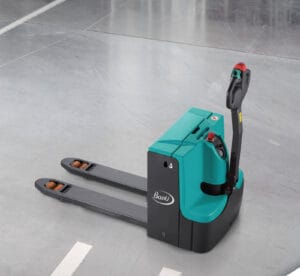
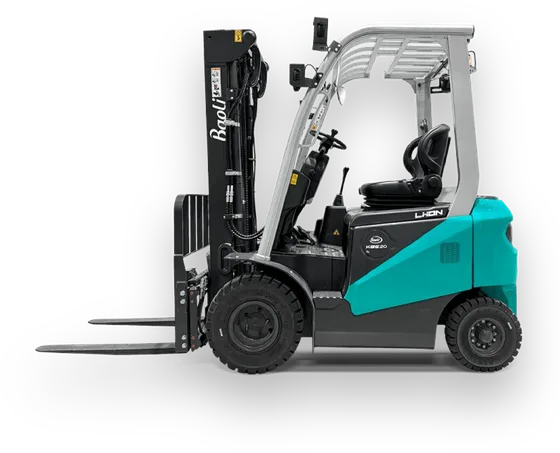
If the height is up to six meters and the aisles are wide, a front electric forklift is a cheaper solution — take a look KBET 15-18-20 or KBE 25-35. If the goods are only transported on a flat surface, it is sufficient electro pallet truck.
Table of specifications
| Item | Value |
|---|---|
| Models | KBR 14 · KBR 16 · KBR 20 |
| Carrying capacity | 1,400 / 1,600 / 2,000 kg |
| Maximum lifting height | 10,655 mm |
| Battery | 48 V / 465–700 Ah; Li-ion optional |
| Motors | alternating current, maintenance free |
| Management | four modes: 180° / 360°, standard and inverse |
| Side shift | integrated on the fork support |
| Display | color, with vehicle information |
| Security | safety devices and light signaling |
| Guarantee for legal entities | 12 months* |
How to get an offer
The forklift is the only category where a no-measurement offer doesn’t make sense, because the machine has to fit in your aisle and reach your top row. We need four pieces of information:
- the width of the aisle between the racks, measured at the narrowest point
- the height of the highest row on which the pallet is placed
- the heaviest pallet and its dimensions
- the number of shifts in which the machine works
With those numbers, you get the exact configuration of the mast, battery and equipment for working at height. Send them through request for quotation or call 021/6040-505. If you are not sure about the measurements, we go out to the field and measure with you.
Baoli KBR 14-20 — reach truck
Photos, technical data and performances are on the model page. For an offer, call us or send an inquiry.
Payment for registered business entities in the Republic of Serbia is made in dinar equivalent at the middle exchange rate of the NBS on the day of payment. You have the whole category on the page reach trucks, and you can service schedule here.
* The guarantee is contracted in accordance with the valid laws of the Republic of Serbia.