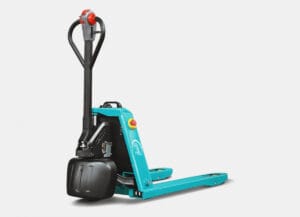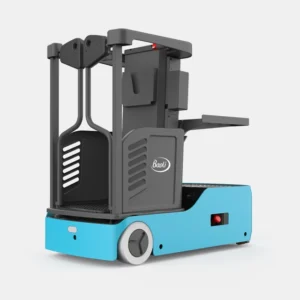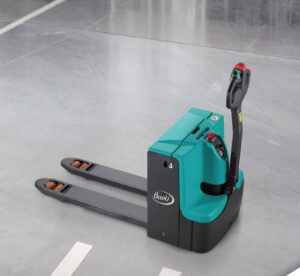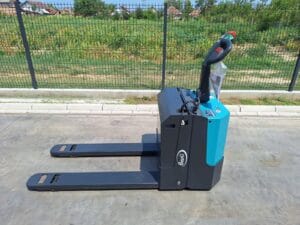
In every warehouse that works in two shifts, there is one moment that got under everyone’s skin: battery replacement. The machine is brought to the charging room, a battery of several hundred kilograms is pulled out with a trolley, another is pushed in, the charger is connected, and all this takes just enough time to disrupt the rhythm of the shift.
With a lithium battery, that moment does not exist. The machine plugs in during a break and goes back to work — no swapping, no second battery, no room.
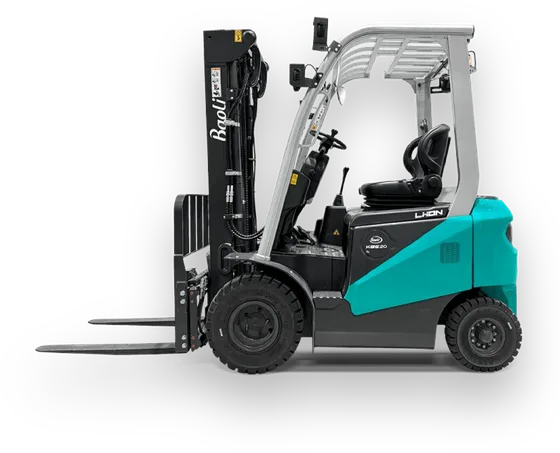
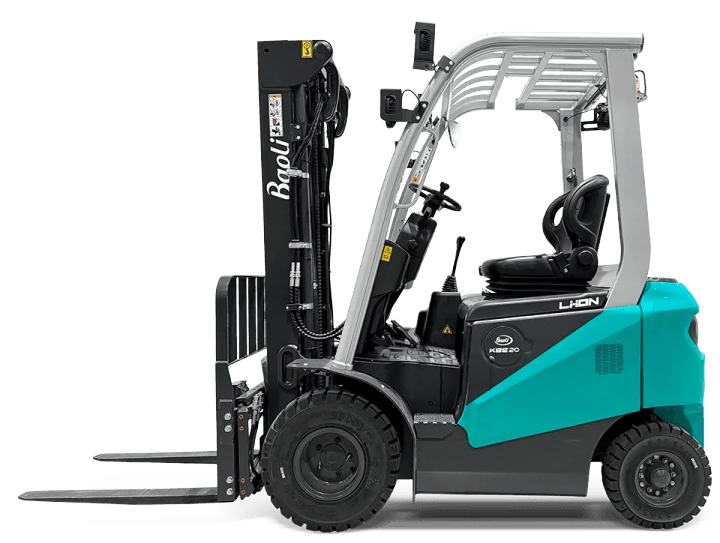
Baoli KBE 18-20 Li-ion is a 1,800 to 2,000 kg front-end electric forklift truck with an 80 V lithium battery. In this article, we look at exactly what changes in a working day — and, frankly, when the difference isn’t worth the money.
Content:
- 1,800–2,000 kg and lifting up to 6,500 mm
- 80 V / 228 Ah: what it means in kilowatt-hours
- Intercharging: operation without replacing the battery
- What all disappears with lithium
- When lithium doesn’t make up the difference
- Modularity: the machine is configurable
- Technical specifications
- Price
1,800–2,000 kg and lifting up to 6,500 mm

Carrying capacity is 1,800 to 2,000 kg with a load center of gravity of 500 mm, and the maximum lifting height 6,500 mm.
That “at 500 mm” is not a formality — it is a condition under which the number is valid. If the euro pallet is taken from the narrow side, the center of gravity moves to about 600 mm and the actual load capacity drops; the same applies when lifting to the highest shelf. We have explained how it is read and calculated in the text The load capacity of a forklift is not a single number.
The two-ton class with a lift of up to six and a half meters covers a typical warehouse with four to five levels of pallets in height. It’s a hall machine — no exhaust, low noise, where people work near it.
80 V / 228 Ah: what it means in kilowatt-hours
It’s a battery lithium-ion, 80 V / 228 Ah. Amp-hours alone don’t say much until multiplied by voltage:
80 V × 228 Ah = 18,240 Wh, i.e. about 18.2 kWh stored energy.
A caveat is important here: amp-hours do not compare between lithium and lead-acid batteries. A lead-acid battery is not fully discharged without damaging its life — in practice, approximately one-half to two-thirds of its rated capacity is used. The lithium one gives a significantly larger part of what is written on the plate, and at the same time it holds uniform voltage until the end of discharge.
The last one is felt the most in the work. With a lead-acid battery, the machine becomes noticeably sluggish towards the end of the shift — lifting is slower, driving is weaker. With lithium, the last pallet rises at the same speed as the first.
Intercharging: operation without replacing the battery

This is the main reason lithium is bought in the first place. Lead battery is looking for full cycle: empty, then fill up to the end, then cool down. Short “as-you-go” charges shorten its life — and that’s why two-shift plants keep a second battery and a replacement cart.
A lithium battery doesn’t work like that. It can be connected for twenty minutes during the break, and again after an hour, without damage to the service life. Instead of one big charge at night, you get a series of small ones throughout the day.
The consequence is organizational, not technical: one battery instead of two, and there is no more “dead” time for replacement. When added up over the year, it’s the biggest item in the calculation — bigger than the difference in the price of electricity.
What all disappears with lithium
- Charging room. The lithium battery does not emit gases during charging, so there is no need for a separate ventilated room — the charger stands next to the workplace. In a warehouse where every square is a pallet space, this is a measurable saving.
- Adding distilled water and regular cell maintenance. The lithium battery is maintenance free.
- Another battery and replacement cart — procurement, space and handling of loads of several hundred kilograms.
- Power loss near the end of the shift. The voltage remains even until the end.
- Risk of acid mishandling — spills, fumes, protective equipment.
What no disappears: the need to follow the manufacturer’s instructions for charging and storage, and for the charger to match the battery. Lithium is simpler, not undemanding.
When lithium doesn’t make up the difference
A lithium machine is more expensive to purchase, and it’s fair to say when that difference isn’t recouped.
If the machine works one shift and stands quietly on the charger at night, a lead-acid battery does the same job for less money. There is no intermediate charge to be exploited, no substitution to be avoided — the main advantages of lithium remain untapped.
If the machine works for few hours per year, the higher number of cycles that lithium offers simply won’t be used up over its lifetime with you.
The rule we suggest is the same as always: count by the worst day of the month, not the average. If there is a day when the machine has to run continuously for more than one shift, the lithium pays off. If there is no such day, take it classic electric machine and save the difference.
How that decision is translated into numbers, we have described in the text How much does a forklift really cost. You can find more about the batteries themselves on the page batteries for forklifts.
Modularity: the machine is configurable
The KBE series is modular — the machine is assembled as required, not bought “as is”. Choose the height and type of mast, workplace equipment, type of tires and connections.
That’s good news, but it requires discipline in ordering. The two most common mistakes are: mast higher than necessary (paid twice — in price and in lost residual capacity) i connection added later without rechecking the load capacity. That’s why before configuration we always ask for the height of the highest rack and the weight of the heaviest pallet.
Technical specifications
| Model | Baoli KBE 18-20 Li-ion |
| Carrying capacity | 1,800 – 2,000 kg at 500 mm |
| Max. lift height | 6,500 mm |
| Battery | lithium-ion, 80 V / 228 Ah (approx. 18.2 kWh) |
| Charging | intermediate charging, without replacing the battery |
| Emission of gases | none — work indoors |
| Configuration | modular — mast, equipment and attachments on request |
Full specifications and catalog are on the page Baoli KBE 18-20 Li-ion. If your burdens are heavier, take a look KBE 25-35; there is a three-wheeler for narrow passages KBET 15-18-20.
Price
The price starts from €17,000.00 + VAT. The final price depends on the load capacity, mast height, equipment and attachments — the machine is modular, so the offer is made by configuration.
The listed prices are without VAT and refer to registered economic entities; payment is made in dinar equivalent at the middle exchange rate of the NBS on the day of payment. It goes with the machine guarantee for legal entities lasting 12 months*, with service and spare parts provided.
For an accurate offer, we need three pieces of information: what is the heaviest pallet, to what height it rises i how many hours a day the machine works. The third piece of information also shows whether you need lithium at all — and if you don’t, we’ll tell you.
Send it request for quotation, call 021/6040-505 (Monday–Saturday, 7:00–15:00) or write to info@viljuskari-jovic.rs.
* The guarantee is contracted in accordance with the valid laws of the Republic of Serbia.
Baoli KBE 18-20 Li-ion
Photos, technical data and performances are on the model page. For an offer, call us or send an inquiry.