The stacker is the machine most often skipped by customers. They look for a forklift, get a quote for a forklift, buy a forklift — and the job they really have is stacking pallets on a rack in a hall with narrow aisles. For that job, the stacker is narrower, cheaper, and easier to maintain.
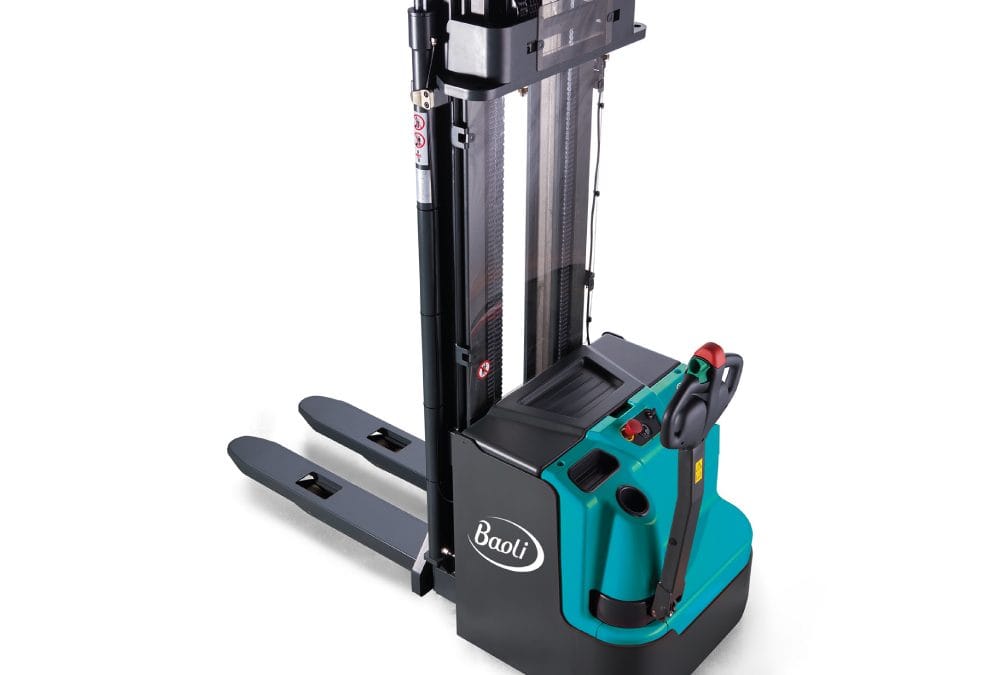
The limit at which the stacker stops being sufficient is usually drawn at one and a half tons. ES 16-N02 he moves that border: he carries it 1,600 kg, has an AC motor and CANBUS electronics, and covers work that would otherwise require a front loader.
Content:
- 1,600 kg: top of the stacker class
- The Four Pillars and Why They Matter
- AC motor and CANBUS: what changes in maintenance
- Battery 24 V / 180–270 Ah
- Long steering arm
- Who is it intended for?
- Technical specifications
- Price
1,600 kg: top of the stacker class

The working range of the machine is 1,200 to 1,600 kg. That sounds like a small difference compared to the usual 1,200 kg in this class, but in practice it changes the list of jobs that the machine covers: full pallets of drinks, packaging, construction materials in bags and finished goods in cartons mostly fit into that range.
As with any lifting machine, there is a rule that cannot be skipped: load capacity decreases with lift height. The number 1,600 kg is valid under standard conditions; on the highest shelf the machine will not carry the same. That’s why the mast height is chosen according to your tallest rack, and the load capacity is checked through the load chart for that particular configuration — not the number in the model name.
Practical: tell us how high the highest shelf is and how much the pallet that goes on it weighs. From those two numbers, you can see whether the ES 16-N02 is the right choice or should be watched electric forklift.
The Four Pillars and Why They Matter

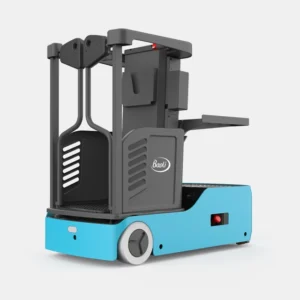
The machine is supported in four points. With the stacker, it is not a detail but a basic design decision, because the load is in front of the machine and everything that rises increases the torque that tries to tilt it forward.
A wider and more stable base means three things in everyday work: a more stable load when lifting to a height, safer movement on a floor that is not perfectly flat, and less feeling of “falling in” when braking with a full load. The operator recognizes it on the first day, even though it is only seen as a drawing in the catalog.
What four supports don’t solve is the uneven terrain outside. Stacker is still a machine for closed spaces with a flat floor — an asphalt lot with holes is not his terrain.
AC motor and CANBUS: what changes in maintenance
Two spec tags that buyers tend to skip, and which have felt the most over the years: alternating current (AC) motor and CANBUS control.
AC motor there is no brush or collector — so there are no parts that wear out during operation and that need to be changed periodically. This means less regular maintenance, better response when moving and, as a rule, more efficient use of energy from the same battery. With a machine that works every day, that difference adds up.
CANBUS is the way electronic parts talk to each other—through a single bus instead of a bundle of individual cables. For you, this means two practical things: fewer cables that can break or oxidize, and diagnostics that show where the fault is rather than searching by method of elimination. When the service technician comes and knows what it is in ten minutes, that’s time the machine doesn’t spend standing still.
Along with that, what can be seen with the naked eye: metal casing of the battery and control electronics protected from water and dirt. It gets spilled, washed and dropped in the warehouse — a case that can withstand that is not a luxury.
Battery 24 V / 180–270 Ah
The machine works on 24 V system, with the battery in range 180 to 270 Ah. That range is a choice, not an indeterminacy — it’s chosen according to how much the machine actually does.
A smaller capacity is cheaper and lighter, and sufficient for one shift with normal breaks. The bigger one makes sense when working for longer periods, when there is no time for intermediate charging, or when the machine is working in a cold area — because the battery capacity decreases at low temperatures.
A rule we always suggest: count by the worst day of the month, not the average. An empty battery at peak times costs more than the price difference between the two capacities. You can find everything about selection, filling and shelf life on the page batteries for forklifts.
Long steering arm
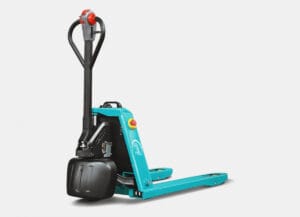
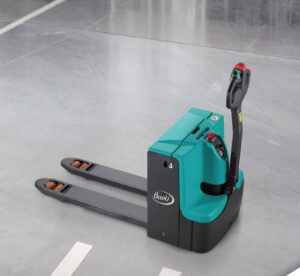
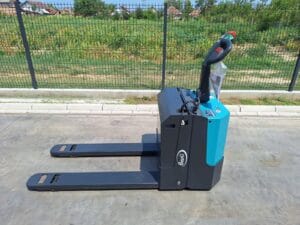
ES 16-N02 is accompanying machine — the operator walks beside her and leads her by the hand of the steering wheel. The length of that arm is an item that reads like a trifle in the catalog, but in the work it means three things.
First, distance: a longer arm keeps the operator further away from the machine and the load, which is the simplest possible protection against a leg being crushed between the machine and the rack. Second, the lever: the machine is easier to guide and turns more precisely in the passage. Third, the position of the body — the controls are at the height where the hand naturally stands, so after eight hours the shoulder is not felt.
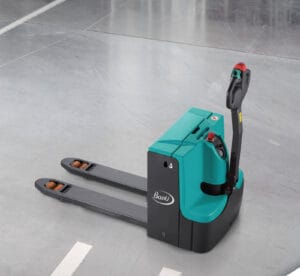
If your machine operator spends all day on the machine and covers longer routes, take a look at models with a standing platform — we wrote about that difference in the text about electric pallet truck EP 20-111.
Who is it intended for?
ES 16-N02 is the right choice for:
- Stacking pallets on the rack in the hall — the basic job for which the machine is made.
- Narrow passages — the stacker is significantly narrower and shorter than a front-end forklift with the same capacity.
- Loads from 1,200 to 1,600 kg — where the smaller stackers of 1,000 and 1,200 kg fit.
- Work indoors — without exhaust gases, with little noise, and where people work close to the machine.
- Companies that would otherwise buy a forklift — and they never leave the hall.
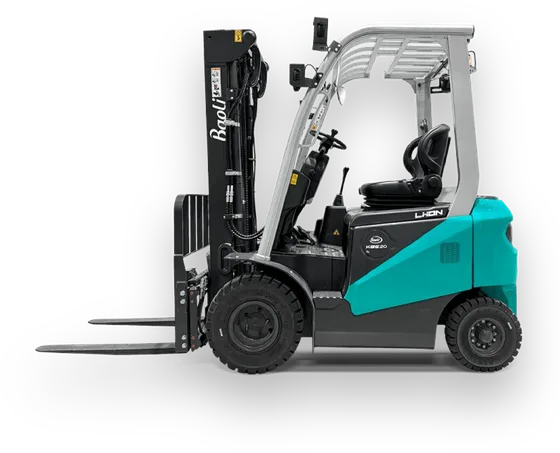
Not the right choice for working in the open and on uneven terrain, for loads over 1.6 tons and for unloading trucks from the ground — that’s where you look diesel or LPG engine. If your loads are lighter and the passage is even narrower, it is a cheaper solution KBS 12 series. And if the goods do not rise at all, it is enough electro pallet truck.
If you’re not sure which category you’re in, start with the guide Pallet truck, stacker or forklift?
Technical specifications
| Model | ES 16-N02 |
| Carrying capacity | 1,600 kg (operating range 1,200–1,600 kg) |
| Battery | 24 V / 180–270 Ah |
| Engine | alternating (AC) |
| Electronics | CANBUS, protected against water and dirt |
| Construction | four supports, metal casing of the battery |
| Management | accompanying, long steering arm |
| Purpose | closed space, flat floor |
The lifting height is selected according to your rack — complete configurations and other models are available on the page electric stackers.
Price
The price is €7,600.00 + VAT. The final price depends on the chosen mast height and battery capacity.
The listed prices are without VAT and refer to registered economic entities; payment is made in dinar equivalent at the middle exchange rate of the NBS on the day of payment. It goes with the machine guarantee for legal entities lasting 12 months*, with service and spare parts provided.
For an accurate offer, we need three pieces of information: what is the heaviest pallet, to what height it rises i how many hours a day the machine works. The mast and battery are also selected from this. If it turns out that a smaller machine is enough for you, we’ll tell you that too.
Send it request for quotation, call 021/6040-505 (Monday–Saturday, 7:00–15:00) or write to info@viljuskari-jovic.rs.
* The guarantee is contracted in accordance with the valid laws of the Republic of Serbia.
Electric stackers in the offer
Look at the models we offer and choose the performance for your business.