Tires are the only part of the forklift that is constantly in contact with the floor and the only one that wears out regardless of how well you maintain the machine. Despite this, they are most often bought by copying the number from an old tire and ordering “the same thing” — and that number is often not the whole information.
This text explains how to read the marking on the tire, which type of tire is suitable for which floor, and when the tire should be changed and not patched.

Content
- How to read the tire size
- Three types of tires and where they go
- How to choose according to floor and mode of operation
- When the tire is changed
- Trelleborg XP series: selection by number of shifts
- Four recurring mistakes
- What to send us with the order code
How to read the tire size
There are two marking methods on forklift tires, and both are read according to the same principle: the first number is the width, the last is the rim diameter.
Inch mark — for example 7.00-12, 6.00-9, 6.50-10. The first number is the approximate tread width in inches, the second is the rim diameter in inches. This is the most common marking on air and solid tires.
Metric notation — for example 250-15. The first number is the width in millimeters, the second is still the diameter of the rim in inches. The unit gets mixed up, and it’s confusing, but it’s common.
Mark with outer diameter — for example 18×7-8. Here the first number is the outer diameter of the tire in inches, the second the width, the third the rim. It is found in superelastic tires and tires for warehouse equipment.
Along with the dimension, there is information about the load capacity and construction. With pneumatic tires, it is a marking PR (number of canvas layers) — 10PR, 12PR, 14PR. A tire of the same size but weaker construction does not carry the same load, and this is a difference that is not visible to the naked eye.
Bottom line: when ordering, copy the entire inscription on the side of the tire, not just two numbers. A photo of the side solves ninety percent of the doubts.
Three types of tires and where they go
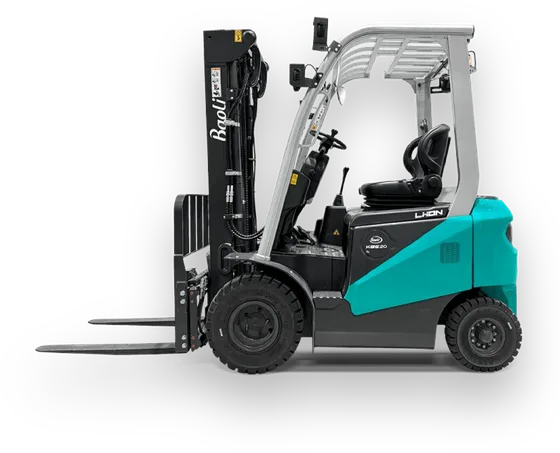
air (pneumatic) — classic tire with air. It absorbs the best, performs best on uneven terrain and outdoors. Disadvantages: breaks through, requires a pressure check and collapses in the middle when the machine sits for a long time.
Poured — pneumatic tire filled with polyurethane mass instead of air. It cannot be punctured, does not require pressure maintenance, and retains the outer shape and pattern of the pneumatic tire. It is heavier and stiffer, so the vibrations are more transmitted to the machine and the operator. A classic solution for a plot with rubble, nails and waste.
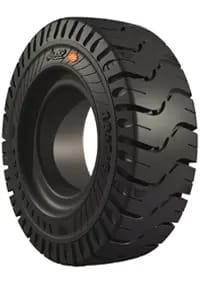
Superelastic (solid tire) — solid rubber without air, cast in layers. It lasts the longest, does not break through and has the smallest height, which gives stability. Requires a relatively flat floor; on uneven terrain it transfers shocks to the machine.
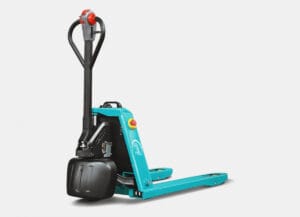
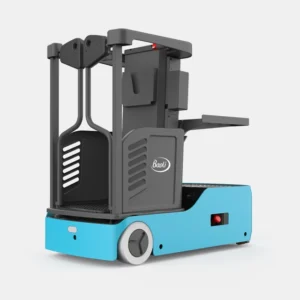
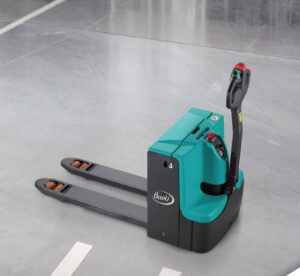
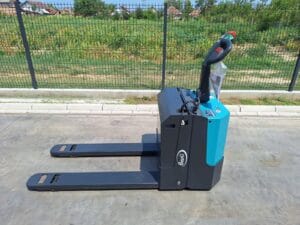
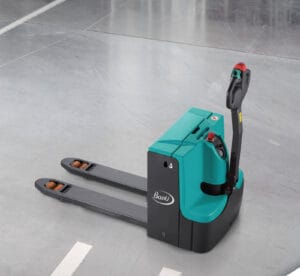
In the case of warehouse equipment — pallet trucks and stackers — the wheels are most often made of polyurethane or tires. Polyurethane is more load-bearing and wears less on concrete, but it slides on a wet floor and leaves a mark on some types of floor. The tire is softer and quieter.
How to choose according to floor and mode of operation
| Where the machine works | Recommendation |
|---|---|
| Closed hall, smooth concrete | Superelastic or polyurethane |
| Hall + ramp, occasionally outside | Superelastic |
| Plot with rubble, nails, waste | Poured |
| Unorganized terrain, mud, earth | Airy with a rough pattern |
| Refrigerator | Tire intended for low temperatures |
| Food industry, clean floor | White or non-tracking rubber |
The last line is often overlooked. Standard black tires leave a mark on a light floor, which can be a problem in the food industry and retail. For this there are white and non-seeking mixtures.
When the tire is changed
The tire is replaced when the wear approaches the sidewall wear line. With some manufacturers, that line is clearly marked and becomes visible when it’s time to replace it — more on that below, with the Pit Stop line.
Regardless of wear, the tire should be replaced immediately if:
- has a cut that reaches the supporting structure
- pieces of the tread are missing
- separates from the rim
- there are bulges or deformations
- is the air tire repeatedly patched in the same place
Tires are changed in pairs on the same axle. The difference in diameter between the left and right tires stresses the differential and changes the behavior of the machine under load.
Worn tires are not just a matter of comfort. The machine on worn tires is lower, so the stability when lifting changes, and the weaker adhesion extends the stopping distance. Daily tire check is the first item on the list in the text about maintenance plan.
Trelleborg XP series: selection by number of shifts
From the Trelleborg program we offer, the selection is organized exactly as the decision is made — by how much the machine works:
| Model | Purpose |
|---|---|
| XP700 | work in one shift |
| XP800 | work in two shifts |
| XP900 | working in three shifts or highly demanding conditions |
| XP1000 | working in three shifts, with a Pit Stop line |
Pit Stop line is an orange strip embedded in the tire that becomes visible when the tire reaches its wear limit. That takes judgment out of the equation: As long as the tape isn’t visible, the tire is working; when it appears, a replacement is planned. In shift work, where several different people look at the tire, this is the simplest way to not miss a replacement.
Four recurring mistakes
- Ordering by memory. “Same as last time” does not cover changing construction or mixing inch and metric markings. A photo of the side of the tire settles the matter.
- Mixing types on the same machine. Air in the front and molded in the back changes the behavior under load.
- Changing one tire. A new tire next to a worn one means a different diameter and uneven load.
- Neglecting pressure in air. A low-pressure tire overheats and wears on the edges, much faster than expected.
What to send us with the order code
To get the quote right the first time, send:
- a photograph of the sidewall of the tire with a legible marking
- make and model of the forklift
- information on whether the tire is front or rear
- where the machine works — indoors, outdoors, or both
- how many shifts per day does the machine work
You are looking for an offer through inquiry form or call 021/6040-505. You have the tire program on the page tires for forklifts, and other consumable parts on the page spare parts. We do the replacement both here and on the field — schedule a service.
Tires for forklifts on offer
Look at the models we offer and choose the performance for your business.